


- Introduction
- Leonardo da Vinci Arrives in Milan
- The Famous Letter to Ludovico il Moro
- Santa Maria delle Grazie and the Dominican Context
- Creating the Last Supper
- The Technique and Its Fragility
- Survival Through Bombs and Restoration
- Interpreting the Scene: Emotions, Composition, and Symbolism
- How to Visit the Last Supper: Tips and Booking Info
Introduction
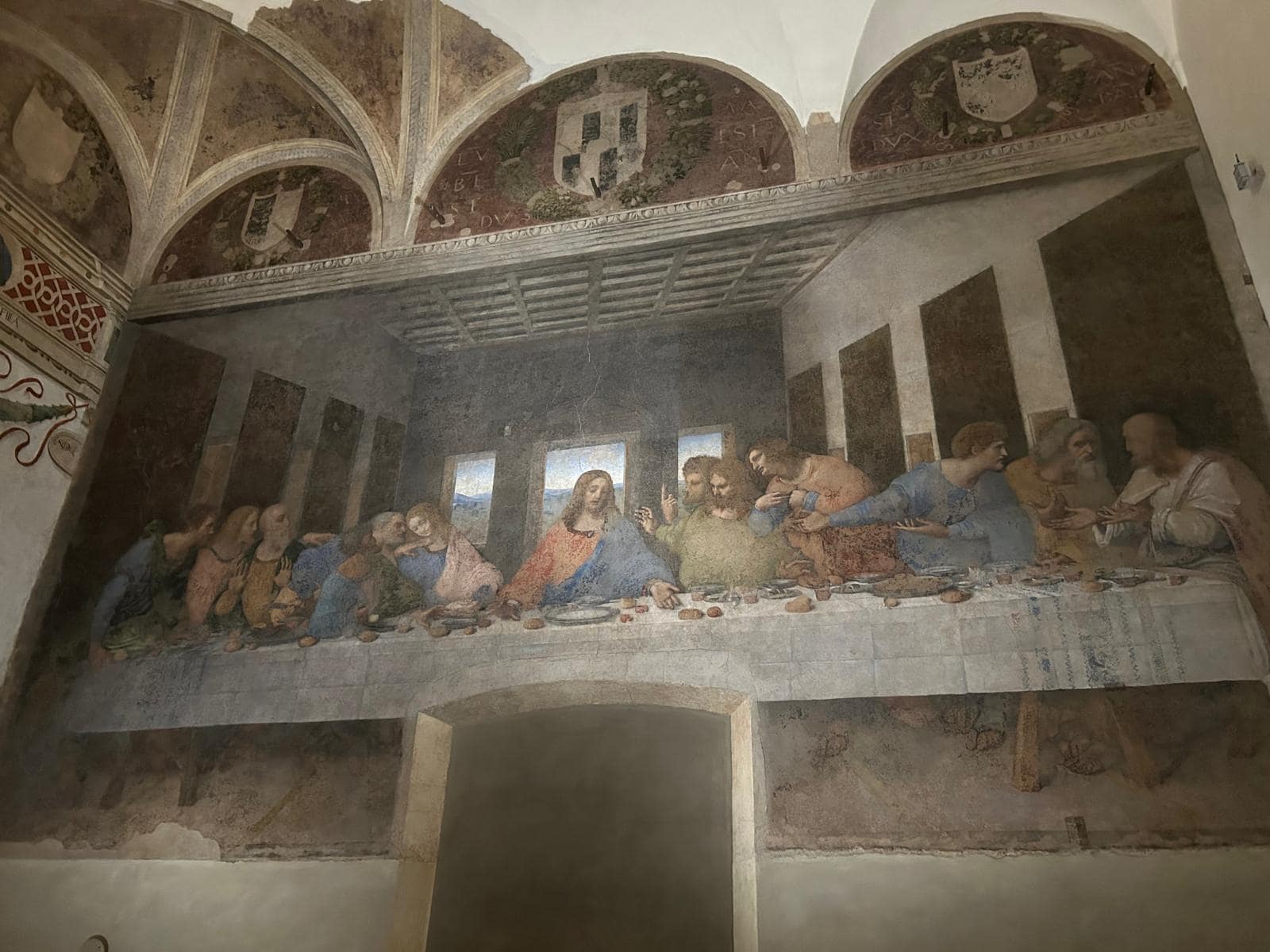
Hidden behind the walls of a former Dominican convent in Milan lies a treasure of the Renaissance: The Last Supper by Leonardo da Vinci. This mural is not just a painting, but a profound narrative of history, artistic innovation, and emotional intensity. I had the chance to visit this masterpiece, and this article reflects both the historical depth and personal impressions from that experience.
To capture the atmosphere of this extraordinary place, here’s a short video showing the emotional impact of entering the refectory where Leonardo’s Last Supper is housed:
Leonardo da Vinci Arrives in Milan
Leonardo da Vinci moved from Florence to Milan around 1482. At the time, he was in his early thirties and seeking new opportunities to apply his wide-ranging talents. Florence was a city of art and letters, but Milan offered the promise of military and engineering commissions. Ludovico Sforza, known as “il Moro,” ruled Milan and was looking for brilliant minds to support his court and political ambitions. Leonardo saw his chance.
The Famous Letter to Ludovico il Moro
Leonardo’s letter to Ludovico is one of the most fascinating documents of the Renaissance. Rather than promoting himself as an artist, Leonardo emphasized his skills in engineering, architecture, and military technology. He outlined designs for bridges, fortifications, cannons, and war machines. It is only at point nine that he mentions painting:
“Also I can execute sculpture in marble, bronze and clay. Likewise in painting, I can do as much as any other, whoever he may be.”
This understated claim would later result in one of the most celebrated religious artworks in the world.
Santa Maria delle Grazie and the Dominican Context
The Dominican friars of Santa Maria delle Grazie were close allies of the Sforza family. They commissioned the decoration of their new refectory, the communal dining space, to honor Ludovico and elevate their own prestige. The chosen subject, the Last Supper of Christ, resonated deeply with their spiritual practices—it was a visual reminder of sacred ritual embedded into daily monastic life.
Adjacent to the refectory is the stunning church of Santa Maria delle Grazie, partially designed by Donato Bramante. Its unique fusion of late Gothic and early Renaissance styles makes it one of Milan’s architectural jewels. Bramante’s work on the apse and cloister reflects a transition in Italian architecture that paralleled Leonardo’s experimental approach to art.
Here’s a short video we took during our visit to Santa Maria delle Grazie, offering a glimpse of the church’s stunning atmosphere:
Creating the Last Supper
Leonardo began painting the Last Supper around 1495 and completed it by 1498. He did not use the fresco technique, which involves applying pigment to wet plaster. Instead, he experimented with oil and tempera on a dry wall, hoping to gain more control over shading and detail. This decision allowed him to work slowly and with precision, particularly in capturing human expressions and gestures.
The mural depicts the moment when Jesus announces, “One of you will betray me.” The apostles are arranged in four groups of three, each reacting differently to the shocking news. From left to right, the figures are:
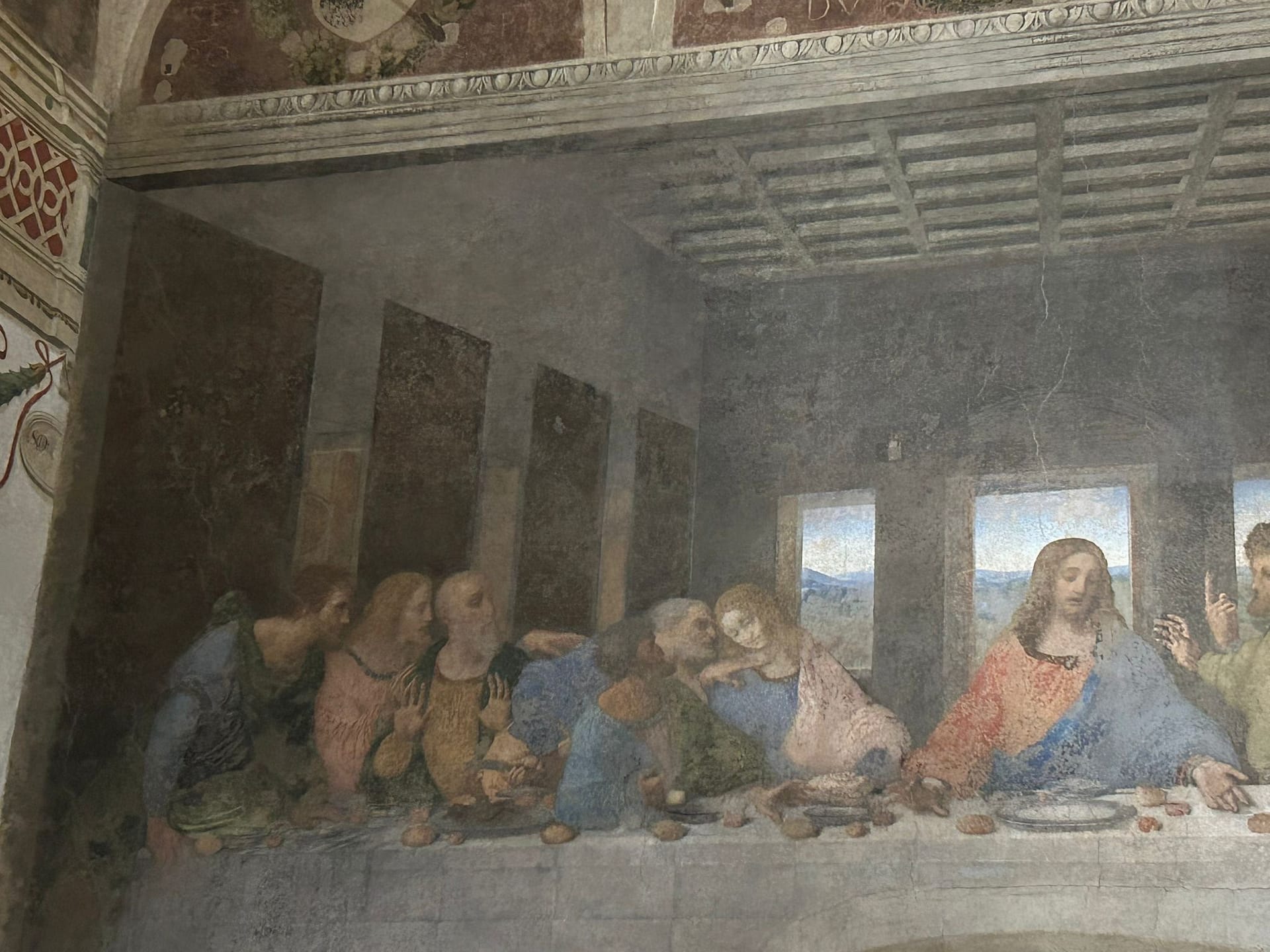
- Bartholomew, James the Less, and Andrew: Bartholomew rises in surprise, James is stunned, and Andrew raises his hands in a gesture of denial.
- Judas, Peter, and John: Judas recoils into shadow, holding a small bag (symbolizing silver); Peter holds a knife and leans toward John, who is youthful and calm.
- Jesus: Alone in the center, serene and composed, forming a triangular shape that symbolizes stability and divinity.
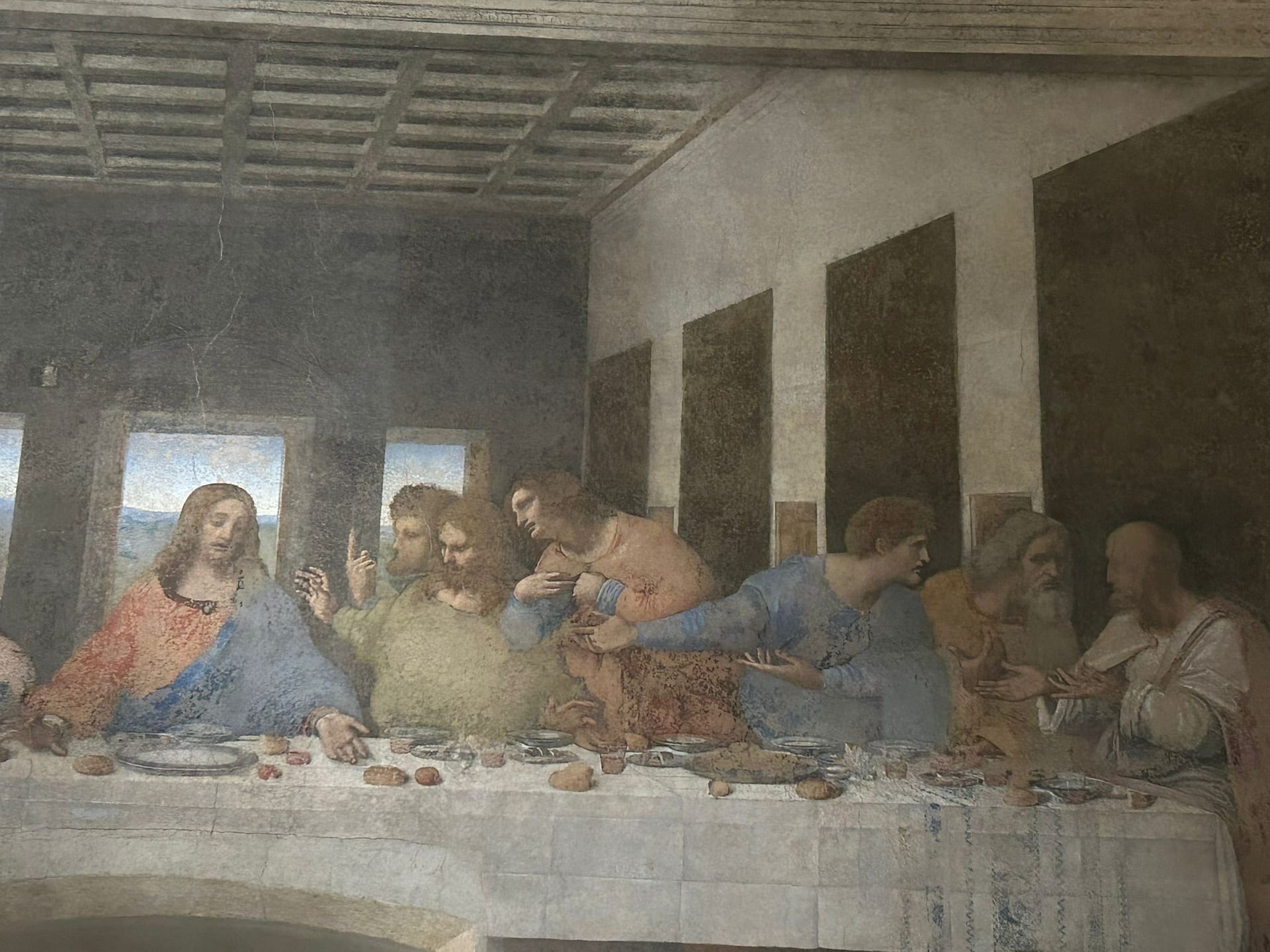
- Thomas, James the Greater, and Philip: Thomas raises his index finger, James spreads his arms in disbelief, and Philip points to himself with innocence.
- Matthew, Thaddeus, and Simon: They discuss the news intensely, turning to each other with questioning gestures.
The Technique and Its Fragility
Leonardo’s choice of medium was revolutionary but problematic. The mixture of oil and tempera applied to dry plaster lacked adhesion and durability. The paint began to deteriorate almost immediately, and by the 16th century, the work was already in poor condition. Over the centuries, moisture, pollution, and failed restoration attempts further damaged the painting.
Leonardo’s experimental method reflects his relentless curiosity. He was not satisfied with tradition—he sought new ways to express depth, light, and emotion. This risk, however, came at the cost of longevity.
Survival Through Bombs and Restoration

During World War II, a bomb hit the convent of Santa Maria delle Grazie, destroying much of the building. Miraculously, the wall bearing The Last Supper survived, thanks to sandbags and scaffolding that protected it. Photographs from the time show devastation around the mural, yet it remained standing—testimony to the care taken to preserve it.
By the 1970s, the painting was at risk of total loss. A monumental restoration effort led by Pinin Brambilla Barcilon began in 1978 and lasted over two decades. The goal was not to repaint, but to stabilize and clean the surviving fragments. Advanced technology, microscopes, and X-rays guided the process. Today, what we see is a delicate composite of Leonardo’s original brushwork and carefully preserved fragments.
Interpreting the Scene: Emotions, Composition, and Symbolism
Leonardo’s Last Supper is not only a religious image but a psychological drama. The viewer’s eye is drawn to Jesus at the center, framed by a large window and bathed in light. His expression is serene, contrasting with the turbulent reactions of the apostles around him.
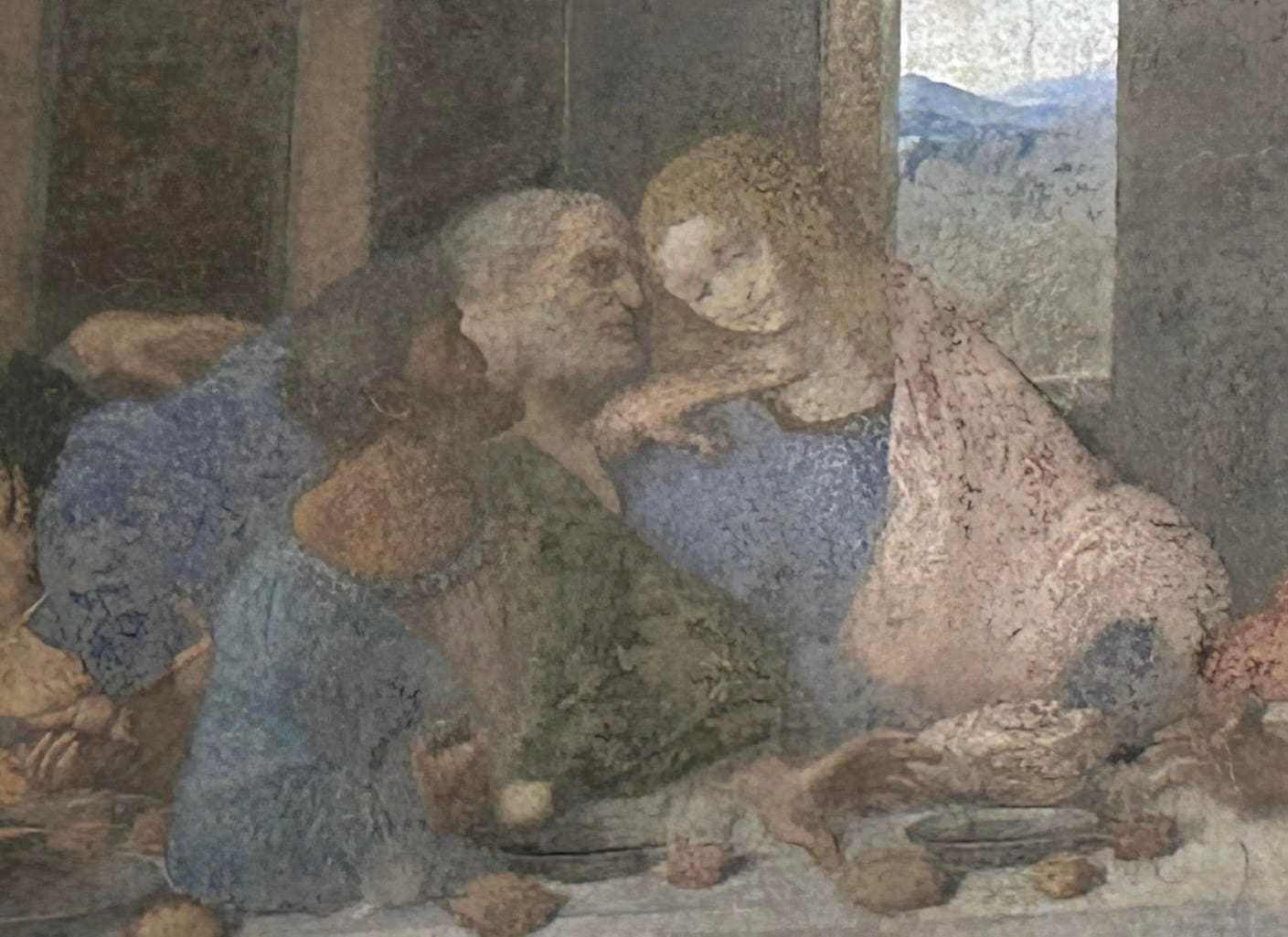
From left to right, we see each disciple reacting differently—Peter with a knife, Thomas raising a finger, Judas retreating into shadow. The figure next to Jesus, often mistaken for Mary Magdalene, is John, the youngest apostle. His youthful, almost feminine appearance has sparked centuries of speculation, but art historians confirm his identity through historical iconography.
The composition uses one-point perspective, with all lines converging behind Christ’s head. This creates a spiritual and visual focus that reinforces his central role in the narrative.
How to Visit the Last Supper: Tips and Booking Info
The Cenacolo Vinciano is one of the most visited cultural sites in Italy. Because of its fragile condition, only small groups are allowed inside for short 15-minute intervals. Booking in advance is absolutely essential.
- Official website: cenacolovinciano.org
- Book in advance: Tickets are released monthly and sell out quickly.
- Free admission: Usually available on the first Sunday of each month (check the official calendar).
- Language tip: Calling the ticket office and speaking in Italian can sometimes help find last-minute slots.
The refectory is located just minutes away from Il Centro, our Italian language school in Milan. We often recommend this visit to our students as part of their cultural immersion. Don’t miss Santa Maria delle Grazie either—Bramante’s architectural masterpiece is free to enter and equally stunning.