



The Martenitsa tradition is one of the most beautiful spring customs in Eastern Europe. Celebrated on March 1st in Bulgaria, it symbolizes health, renewal and happiness. This year, the Martenitsa arrived in Milan in a very special way — through a heartfelt gift sent to Il Centro, our Italian language school in Milan, by one of our most inspiring students.
Yesterday something truly beautiful happened at Il Centro.
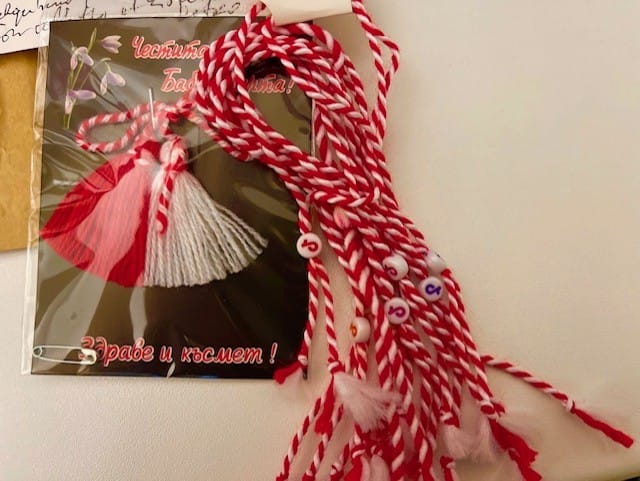
We received a parcel from Bulgaria. Inside, dozens of red and white bracelets: the traditional Martenitsa, a symbol of spring, renewal, health and happiness.
The gift was sent by Petko, our oldest student.
85 years old. A Bulgarian medical professor. A brilliant, curious and enthusiastic mind.
Petko studied Italian with us in Milan and fully embraced school life. He participated with energy in lessons, conversations and even in Marco’s cultural trips. He was never just sitting in class — he was present, engaged, alive.
He reminded all of us that there is no age limit to learning.
Our communicative-affective method — humanistic, engaging and dynamic — always starts from real-life situations and naturally leads students to grammar. It places the person at the center of the learning experience. And it truly works for students of every age.
Petko is living proof of that.
A Letter That Touched Our Hearts
Inside the parcel, there was also a handwritten letter. One passage moved us deeply:
“The red and the white symbolize health and happiness — may they always be with you. Studying at your school is a dear memory; I often think about it. Thank you very much, with affection and respect, Petko.”
Simple words. Full of meaning.
What Is the Martenitsa?
The Martenitsa tradition is celebrated on March 1st in Bulgaria during the feast of Baba Marta (“Grandmother March”).
People exchange red and white bracelets as a wish for health, happiness, prosperity and new beginnings.
Red represents life and energy. White symbolizes purity and hope.
The bracelets are worn until the first sign of spring appears — a blossoming tree or a stork — and then they are hung on a branch as a symbolic gesture of good fortune.
It is an ancient tradition filled with poetry and meaning.
Read more about its historical origins here: The story of the Martenitsa.
Connected Traditions Across Europe: The Mărțișor
This tradition has cultural relatives in other countries too. In Romania and Moldova, a similar celebration takes place on March 1st, known as the Mărțișor.
It also involves red and white threads or small charms exchanged as symbols of spring, protection, luck and renewal.
The Mărțișor is considered a millenary tradition that connects communities through shared values and seasonal symbolism.
You can discover more about this beautiful custom here: The ancient tradition that unites the Moldovan people.
Across borders and cultures, spring has always been a moment of rebirth, hope and human connection.
More Than a School
Receiving this parcel was not simply about receiving bracelets.
It felt like receiving an embrace.
It reminds us of the bonds we build with our students — bonds that continue even after the course ends.
Il Centro is a small Italian language school in the heart of Milan, but it is a place where something unique can be felt from the very first day.
A warm, human atmosphere that is difficult to find elsewhere.
Many students arrive to study Italian in Italy. Many leave as part of our extended family.
Thank you, Petko, for bringing spring to Il Centro and for reminding us that enthusiasm has no age.