


From handmade pasta to the Italian idea of convivialità, discover why Italian food traditions are such an important part of experiencing Italy — and learning the Italian language.
Italy has always fascinated international visitors with its art, landscapes, fashion, history and lifestyle. But often, the deepest connection with Italian culture begins in a much simpler place: around a table, preparing and sharing food together.
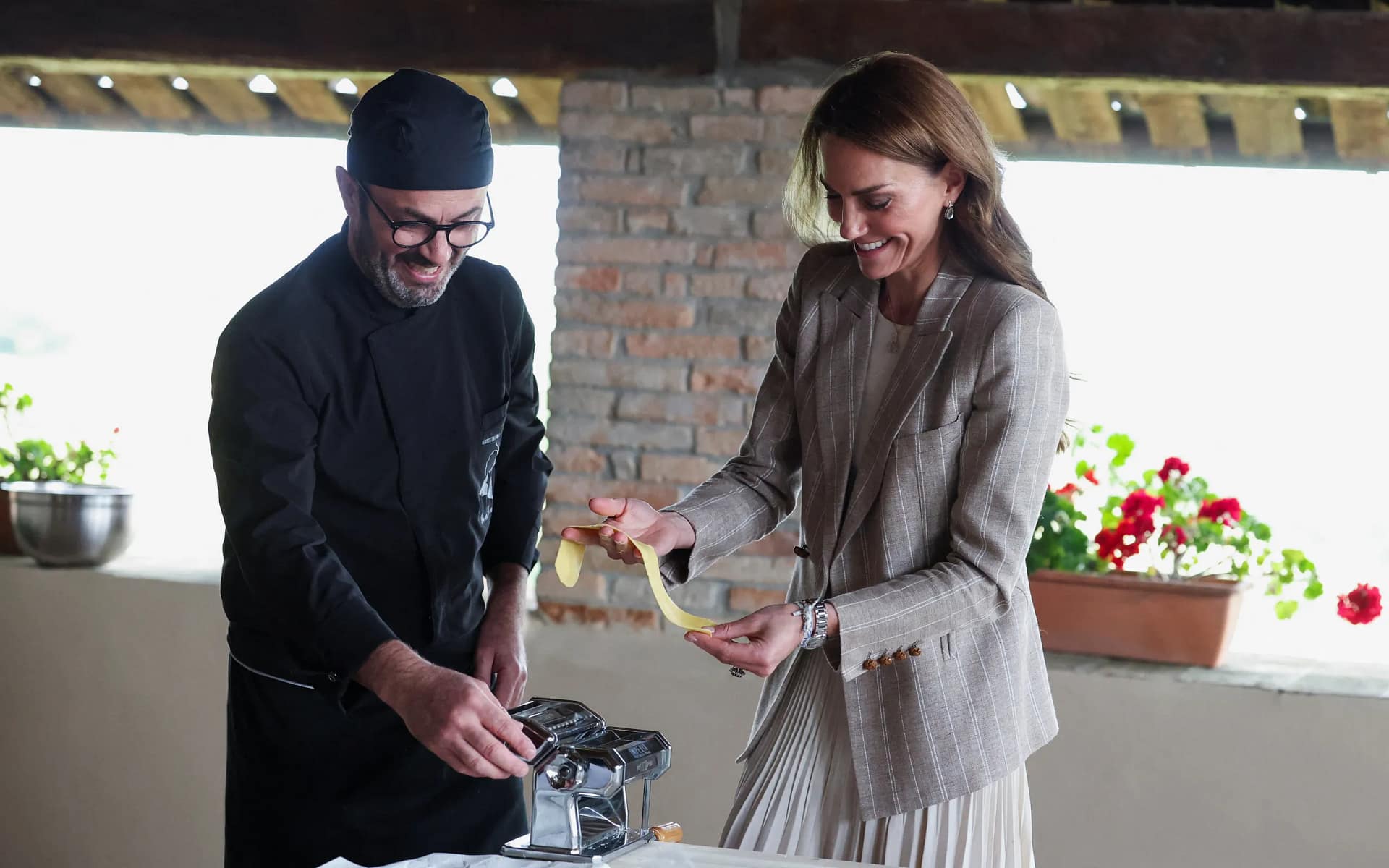
During her recent visit to Italy, Princess Kate experienced one of the country’s most authentic traditions by learning how to make fresh pasta in Emilia-Romagna alongside local families and traditional home cooks.
Far from royal protocol and official ceremonies, the moment revealed something deeply Italian: the importance of convivialità — the Italian idea of sharing time, conversation and human connection through food.
In Italy, meals are rarely just about eating. They are moments of family, storytelling and traditions passed down from one generation to the next.
More Than Food: A Cultural Experience
For many foreigners, Italian cuisine initially represents pleasure and beauty: fresh pasta, pizza, espresso, regional recipes and long dinners shared with friends.
But after spending time in Italy, many visitors discover something deeper.
Food in Italy is connected to identity, memory and local traditions. Every region has its own recipes, ingredients, idiomatic expressions and culinary rituals that reflect centuries of history.
In Emilia-Romagna, handmade pasta is still prepared according to traditions carefully preserved by local families.
One of the most fascinating words connected to this tradition is rezdore, a term from the Emilia-Romagna region traditionally used to describe the women who preserve the culinary culture of the household.
Another beautiful Italian word is sfoglia, the thin sheet of fresh pasta dough prepared by hand with flour, eggs and a rolling pin.
And then there is the expression fare la pasta a mano — literally “to make pasta by hand.”
These are not simply cooking techniques. They are part of everyday Italian culture.
Why Food Is Part of Learning Italian
For many international students, learning Italian is not only about grammar rules or vocabulary exercises.
It is also about understanding gestures, traditions, social habits and the everyday rituals that define Italian life.
Food naturally becomes part of the language-learning experience itself.
Students quickly discover that Italian conversations often revolve around meals, recipes, regional dishes, coffee culture and invitations to eat together.
At Il Centro – Italian Language School Milan, we often see how students connect more deeply with the Italian language precisely through cultural experiences linked to Italian cuisine, local traditions and everyday life in Milan.
Many students arrive in Italy thinking they are only coming to study a language. Then they discover local markets, aperitivo culture, family-run trattorie, regional dishes and traditional recipes — and little by little, they begin to understand Italy from the inside.
This is also why Italian food culture is one of the most appreciated topics on our blog.
If you would like to explore more about Italian cuisine, traditions and everyday culture, you can also visit:
The Italian Idea of Convivialità

Perhaps one of the most difficult Italian concepts to translate is precisely convivialità.
In English, it can be translated as conviviality or togetherness, but the Italian meaning goes deeper. It describes the pleasure of spending time together around food, conversation and shared experiences.
A long dinner with friends.
A Sunday lunch with family.
Fresh pasta prepared together in the kitchen.
Coffee after lunch while talking for hours.
These moments are considered an essential part of Italian quality of life.
And perhaps this is exactly what Princess Kate experienced during her time in Italy.
Not simply Italian food itself, but the atmosphere, traditions and human connection that surround it.
Because in Italy, food is never simply food.
It is culture.
It is identity.
It is memory.
And above all, it is connection.
Photo credit: ELLE Italia, La cucina italiana