



If you love art and want to learn Italian in a creative way, exploring the works of Michelangelo Merisi da Caravaggio is the perfect choice. His paintings are visually stunning and rich in vocabulary, expressions, and cultural references that bring the Italian language to life.
Who was Caravaggio?
Born in 1571, Caravaggio revolutionised painting with dramatic contrasts of light and shadow—chiaroscuro. His works capture intense human emotions and tell stories with bold realism and striking detail. His life was as dramatic as his art.
Masterpieces to discover

The Calling of Saint Matthew (1599–1600)
A sudden beam of light cuts through a dim tavern, freezing the instant of Matthew’s spiritual awakening. Faces turn, hands gesture, doubt and destiny collide. It’s a textbook use of chiaroscuro. Learn Italian words like vocazione (calling), sguardo (gaze), gesto (gesture). Location: San Luigi dei Francesi, Rome.
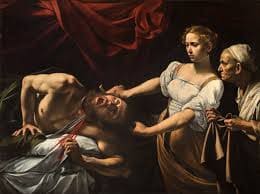
Judith Beheading Holofernes (c. 1599)
An unsettling, dramatic moment: Judith’s resolve, the tension of her grip, the shock of red against darkness. Practise descriptive Italian: coraggiosa (courageous), determinazione (determination), riluttante (reluctant), spietata (ruthless).
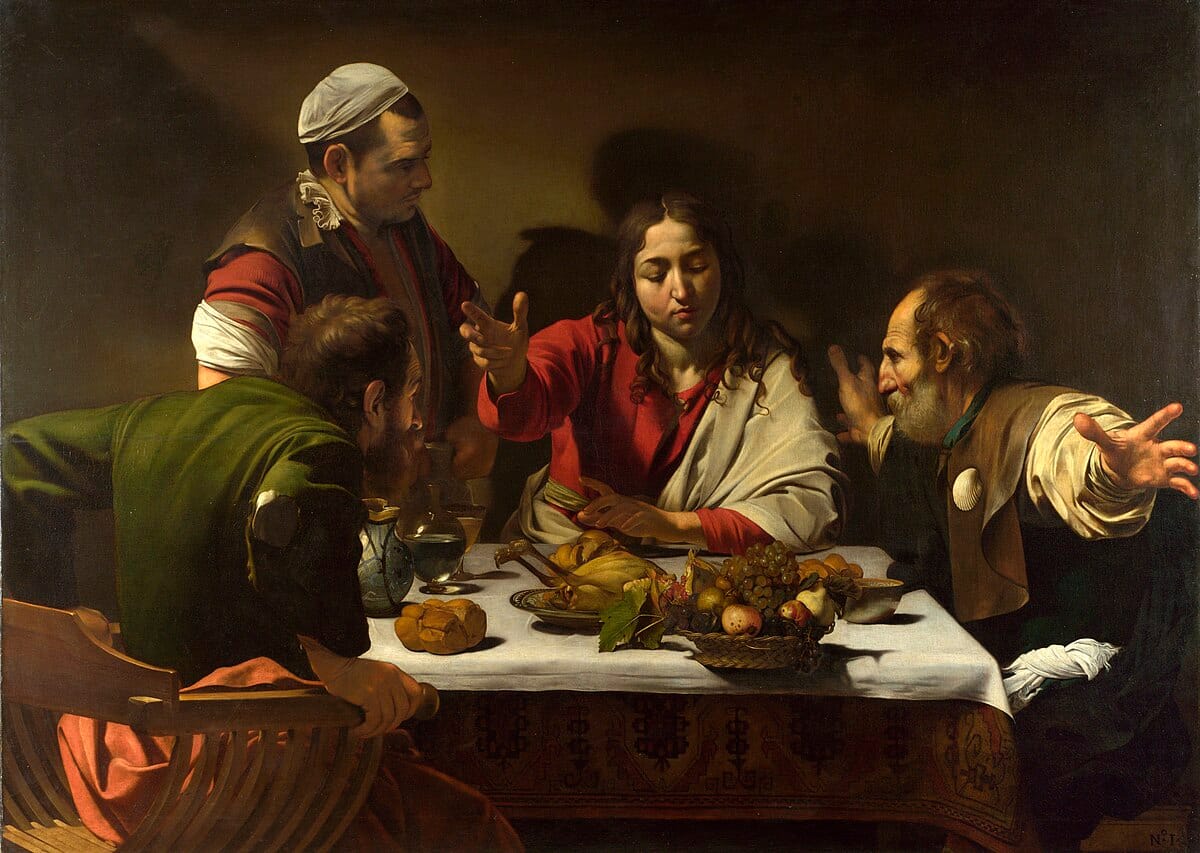
Supper at Emmaus (1601)
An inn scene where two disciples recognise the risen Christ as he breaks bread. Gesture, expression, and still-life details abound. Great for vocabulary: stupore (astonishment), banchetto (banquet), presenza (presence).

Basket of Fruit (1597–1600)
Author: Caravaggio
Date: 1597–1600
Technique: Oil on canvas
Dimensions: 46×64 cm
Location: Pinacoteca Ambrosiana, Milan
Basket of Fruit is considered one of the earliest still-life paintings. It synthesises late Mannerist interests in grand natural displays and, through its unusual equatorial viewpoint, reflects Caravaggio’s focus on inanimate subjects as central and complete, rather than peripheral to the human figure.
The still-life theme was already present in Hellenistic art (3rd–2nd centuries BC) and in the mosaics of Pompeii, Herculaneum and Stabiae (1st century BC – 1st century AD). It also carried rich symbolic and religious connotations, becoming an autonomous genre during the Counter-Reformation. By the late 16th century, still-life painting was part of the iconographic renewal of devotional art, following the Council of Trent’s recognition of the capacity of natural elements to inspire devotion through their immediacy.
🎨 Expressions from the art world
Colpo di scena
A sudden twist or reveal—common in art and storytelling.
In primo piano
The foreground—where key details often appear in Caravaggio’s paintings.
Giocare con la luce
To play with light—an artistic technique to add contrast and drama.
🖋 Exercise: Complete the text (past tenses)
Fill in the gaps with the correct Italian past tense (imperfetto or passato remoto).
Michelangelo Merisi, detto Caravaggio, __________ (nascere) a Milano nel 1571. Fin da giovane __________ (mostrare) un grande talento per la pittura. Nel 1592 __________ (trasferirsi) a Roma, dove __________ (iniziare) a lavorare per importanti mecenati. Le sue opere __________ (essere) note per il forte contrasto di luci e ombre, tecnica che __________ (diventare) famosa come chiaroscuro. La sua vita __________ (essere) intensa e spesso segnata da episodi violenti; in un’occasione, addirittura, __________ (doversi) fuggire da Roma dopo un duello. Nonostante ciò, le sue tele __________ (influenzare) profondamente la pittura europea.
Show solutions
Michelangelo Merisi, detto Caravaggio, nacque a Milano nel 1571. Fin da giovane mostrava un grande talento per la pittura. Nel 1592 si trasferì a Roma, dove iniziò a lavorare per importanti mecenati. Le sue opere erano note per il forte contrasto di luci e ombre, tecnica che divenne famosa come chiaroscuro. La sua vita era intensa e spesso segnata da episodi violenti; in un’occasione, addirittura, dovette fuggire da Roma dopo un duello. Nonostante ciò, le sue tele influenzarono profondamente la pittura europea.
🇮🇹 Learn Italian in Milan
At Il Centro – Italian Language School in Milan, we believe art is a powerful tool for language learning. Our courses are enriched with cultural experiences like museum visits and art-based language workshops.
Join us in Milan and let Caravaggio’s light guide your Italian fluency!