




“But ChatGPT told me this was correct.”
We hear this sentence more and more often in our Italian classes.
A student wants to say something in Italian, asks an AI tool to translate it, copies the answer and confidently uses it in class.
Then everyone looks confused.
Sometimes the sentence is grammatically correct but sounds unnatural. Sometimes it is too formal. Sometimes it is completely wrong for the situation.
And the student says:
“It wasn’t my fault. ChatGPT translated it.”
But here is the truth: the problem is usually not the AI. The problem is how we ask AI to help us.
AI Is an Incredible Tool
At Il Centro, our Italian language school in Milan, we use artificial intelligence ourselves. We have already written about AI and Italian language apps, and about how we combine AI and music to create creative Italian lessons.
We are not afraid of technology. Quite the opposite: we believe every language teacher should learn how to use it well.
The challenge is not whether to use AI. The real challenge is learning how to use it intelligently.
AI Is Not a Mind Reader
Many students write very short prompts, for example:
Translate: “I’m cool.”
But what does that sentence mean?
- Does it mean “I’m relaxed”?
- Does it mean “I’m fashionable”?
- Does it mean “I’m calm”?
- Does it mean “I’m not worried”?
- Does it mean “I’m cold”?
An AI model has no idea. It has to guess. And every guess changes the translation.
Translation Is Not Language Learning
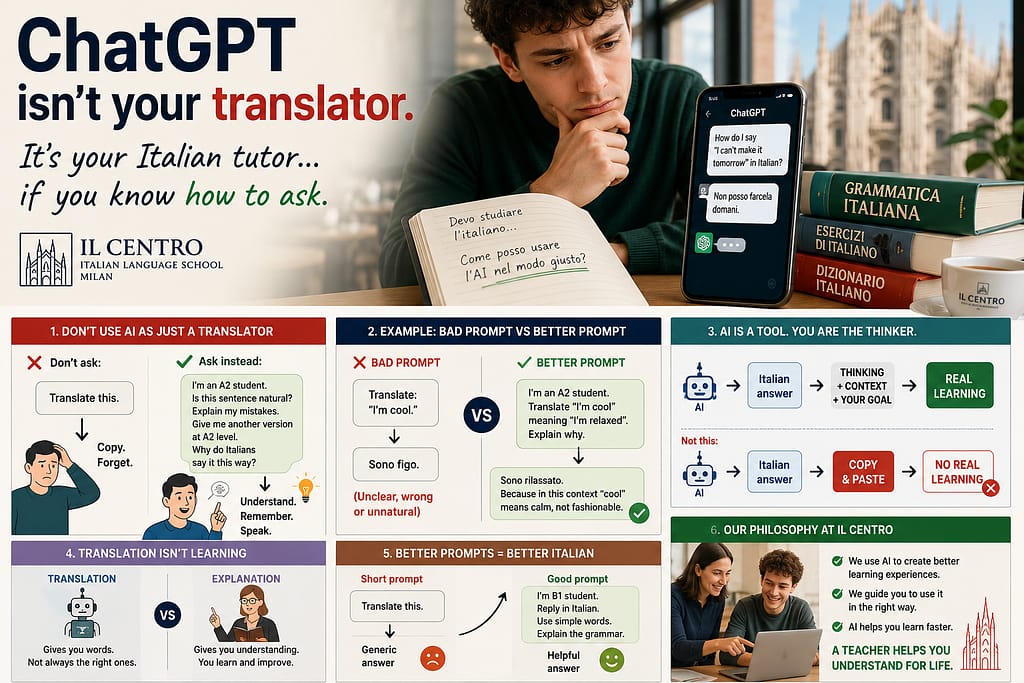
This is probably the biggest mistake students make. They think learning Italian looks like this:
Native language → AI → Italian → done.
Unfortunately, that is not how languages work.
Language is context. Culture. Tone. Situation. Relationship between speakers. Register. A translation cannot explain all of that unless you ask for it in the right way.
ChatGPT Italian translation mistakes: AI Does Not Know Your Level
Your teacher knows whether you are studying at A1, A2, B1 or B2 level. AI does not, unless you tell it.
You ask for a translation. It may answer with C1 Italian, legal Italian, business Italian or expressions that Italians almost never use in everyday conversation.
The sentence may not be grammatically wrong. It may simply be the wrong sentence for you, for your level and for the situation in which you want to use it.
The Real Skill Is Writing Good Prompts
This surprises many people. Everyone says AI is easy. Actually, using AI well is becoming a skill in itself.
Writing a good prompt is often difficult, even for native speakers. Imagine how much harder it can be for someone who is learning a foreign language.
If you give AI a vague question, you may receive a vague or inappropriate answer. If you give AI context, level, purpose and tone, the answer becomes much more useful.
Do Not Use AI Only as a Translator
ChatGPT Italian translation mistakes? Instead of asking AI to speak instead of you, ask it to help you speak better.
For example, instead of writing:
Translate this sentence into Italian.
Try this:
I am an A2 Italian student. Is this sentence natural in Italian? If it is wrong, do not rewrite everything. Explain my mistakes. Give me another version at A2 level. Tell me why Italians would say it this way.
Now AI is helping you learn. It is not replacing your thinking.
Use AI as a Language Tutor
A translator gives you an answer. A tutor helps you understand why that answer is correct.
This difference is very important. If you only copy a translation, you may remember nothing. But if you ask AI to explain grammar, vocabulary, tone and context, you can turn a simple translation into a learning activity.
For example, you can ask:
- Is this sentence natural in spoken Italian?
- Is it formal or informal?
- Can an A2 student say this?
- What is the simplest way to express this idea?
- What mistake did I make?
- Can you explain this correction in English?
- Can you give me three examples with the same structure?
In this way, AI becomes a support for your learning process, not a shortcut that prevents you from learning.
A Bad Prompt and a Better Prompt
Here is a simple example.
Bad prompt:
Translate: “I can’t make it tomorrow.”
The translation may be correct, but you will not know when to use it, whether it is formal or informal, or whether it matches your level.
Better prompt:
I am studying Italian at A2 level. I want to say “I can’t make it tomorrow” to a friend. Give me three natural ways to say it in spoken Italian. Explain the difference between them and tell me which one is the most common.
This is much more useful because the AI now has context: your level, the situation, the relationship and the tone.
This Is How We Use AI at Il Centro
If your dream is to learn Italian in Milan, At Il Centro, we do not ask AI to do the learning for students. We use it to create better learning opportunities.
We use AI to prepare conversations, generate grammar exercises, create listening activities, analyse songs, explain difficult expressions and personalise homework.
But there is always a teacher who guides the process. Because AI can generate answers, but a teacher helps students understand them.
The Future Is Not Teachers Versus AI
Some people think artificial intelligence will replace language teachers. We do not.
The future is not teachers or AI. The future is teachers who know how to use AI, helping students learn how to use it well.
That is a completely different future.
How to Make AI Help You Learn Italian Better
AI can help you learn Italian faster than ever before, but only if you use it to think more, not to think less.
The best students will not be the ones who use AI the most. They will be the ones who know how to ask the best questions.
So next time you want to translate something into Italian, do not simply ask AI for the answer. Ask it to help you understand the answer.
That is where real learning begins.